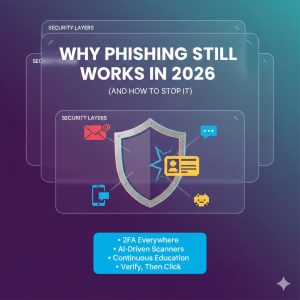
Why Phishing Still Works in 2026 (and How to Stop It)
Phishing remains one of the most common entry points for cyber incidents in small and mid-sized businesses.
And it’s not because employees are careless—it works because attackers have gotten better, faster, and far more targeted.
If your business operates in The Woodlands, TX (or the greater Houston area), this matters because modern phishing campaigns
are designed to blend into everyday workflows: invoices, HR requests, vendor messages, and seasonal promotions.
Why Phishing Still Works in 2026
Most phishing emails today don’t look suspicious. They reference real vendors, real staff, real events,
and even current seasons or holidays. That’s not random—it’s intentional.
- Timing: Attackers choose moments when people are busy or distracted.
- Context: Messages mirror normal business language and vendor formats.
- Targeting: Attackers tailor campaigns by industry and role (billing, HR, leadership).
The result: even smart, well-meaning people can click a link or enter credentials because the email feels normal.
Why “Once-a-Year Training” Fails
Annual security training creates awareness, but it doesn’t build habits.
Employees forget. Attack styles evolve. New threats appear.
By the time the next training rolls around, attackers have already adapted. That’s why we recommend
short, ongoing reinforcement—quick tips and realistic simulations that match what users actually see in their inbox.
Why Email Filtering Alone Isn’t Enough
Email filtering is essential, but it’s not perfect. Even top-tier filtering platforms will occasionally let a message through.
Attackers rotate domains, IPs, and content to slip past detection.
The danger is relying on a single layer:
- “We have email security, so we’re covered.”
- “We trained staff last year, so they should know better.”
In real environments, phishing succeeds when one layer fails. Good security planning assumes that will happen.
The Practical Fix: Layered Defense (What Actually Reduces Risk)
Businesses in The Woodlands that reduce phishing risk over time use layered controls that assume something will eventually get through.
Here’s the model we implement in many SMB environments:
1) Ongoing Training & Simulations
Short, periodic phishing simulations and reminders keep security top-of-mind and show where coaching is needed.
2) Email Filtering & Link Protection
This blocks the bulk of malicious messages before they reach your team and reduces overall exposure.
3) Login Monitoring (Microsoft 365 + SaaS Monitoring)
If credentials are compromised, unusual sign-ins and risky behavior must be detected quickly so you can secure accounts
before damage spreads.
4) Response Playbooks (So You Don’t Have to Guess)
When a user clicks, speed matters. A simple playbook typically includes:
- Lock the account / revoke sessions
- Reset credentials and validate MFA
- Review recent sign-ins and mail rules
- Confirm no lateral movement or data access
This shifts your posture from “hope nothing gets through” to assume something gets through and limit impact.
Phishing Clicks Aren’t Failure—They’re Feedback
When someone clicks a phishing email, it’s not a personnel problem. It’s a security signal.
It tells you what attackers are trying, what styles are working, and where controls need improvement.
- Which departments are being targeted
- Which attack themes are most convincing
- Where training and filtering need adjustment
Organizations that treat clicks as feedback improve. Organizations that treat clicks as blame tend to repeat incidents.
Quick Checklist: Is Your Business Protected?
- Do you run phishing simulations more than once per year?
- Do you have modern email filtering plus link protection?
- Do you monitor Microsoft 365 logins for risky sign-ins?
- Do you have a written response playbook for clicks and suspicious logins?
The Bottom Line for The Woodlands Businesses
If your security strategy depends on annual training, email filtering alone, or hoping users catch everything,
you’re depending on luck.
A practical security posture assumes mistakes will happen—and designs systems to catch issues quickly,
contain risk, and recover cleanly. That’s how phishing risk actually goes down over time.
Need The Woodlands IT Support Help With Email Security?
If you’d like a second set of eyes on your email security and Microsoft 365 sign-in protection,
we can run a quick review and share practical improvements.
Scorpion Technology LLC — Local IT Support serving The Woodlands and the Houston area.

