If you run a MedSpa in Houston, you probably didn’t get into this business to become an expert in federal data privacy law. But HIPAA is real, and the fines for non-compliance are too — up to $1.9 million per violation category, per year. The IT systems behind your MedSpa are often where compliance breaks down, and most practice owners don’t find out until there’s a breach or an audit.
This checklist covers the specific IT requirements your MedSpa needs to meet under HIPAA’s Security Rule. It’s written for practice owners, not IT people — so no jargon, no scare tactics, just what you actually need to know and do.
What HIPAA Actually Requires from Your IT
HIPAA’s Security Rule requires that any business handling Protected Health Information (PHI) — patient names, contact info, treatment records, photos — must put technical safeguards in place to protect that data. For MedSpas, that covers everything from how your front desk logs into your booking system to how client photos are stored on your staff’s phones.
The problem is that most MedSpas weren’t built with IT infrastructure in mind. You’ve got booking software, payment systems, client photo galleries, email, and sometimes cloud storage — all running on whatever equipment was handy when the business opened. That patchwork setup is exactly where HIPAA violations happen.
The good news: getting compliant doesn’t require ripping everything out and starting over. Most of the time, it’s about applying the right configurations and policies to what you already have.
The IT Checklist Every Houston MedSpa Needs
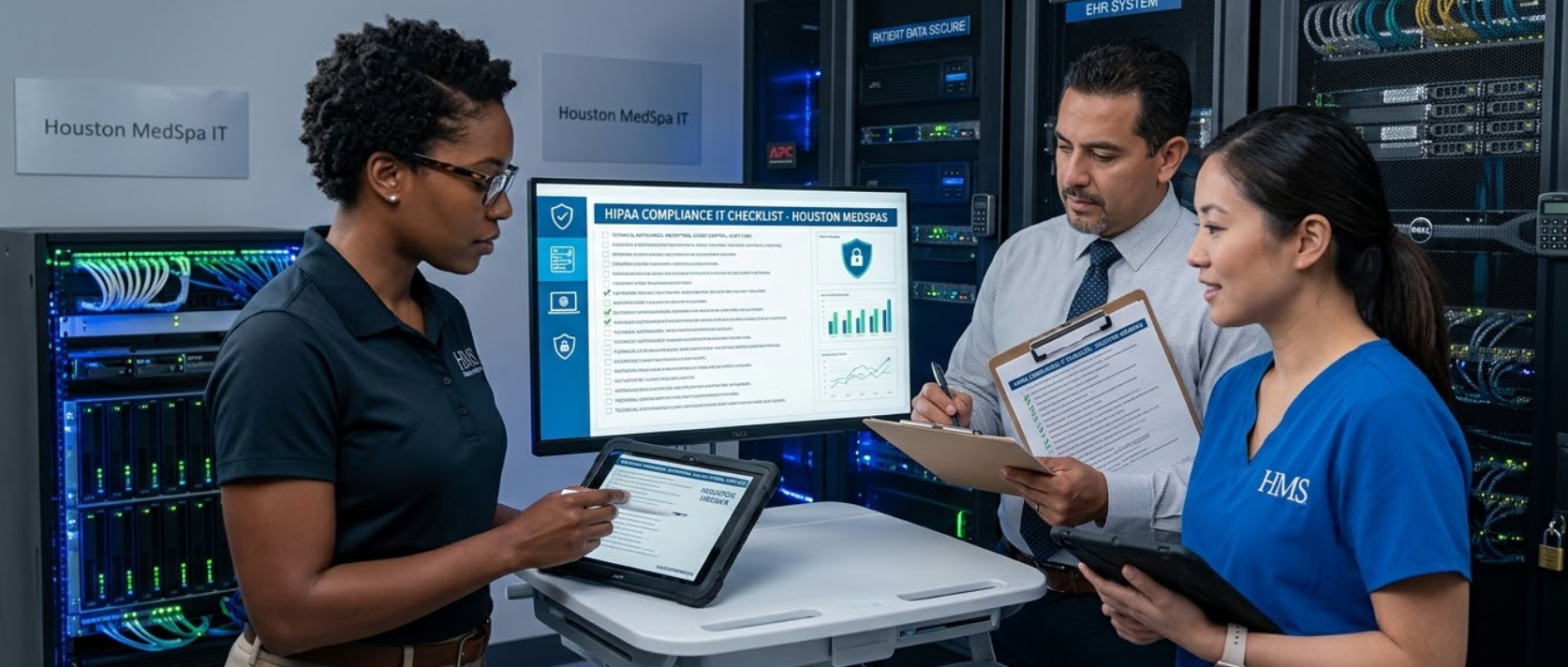
Here’s what a HIPAA-compliant IT setup looks like in practice. Work through this list and note anything you can’t confidently check off.
- Encrypted devices. Every computer, tablet, and phone that touches client data must use encryption. If a laptop gets stolen, encrypted data stays protected. This is a baseline HIPAA requirement, not a nice-to-have.
- Unique logins and strong passwords. Shared staff logins are a HIPAA red flag. Every employee needs their own credentials. Multi-factor authentication (MFA) — where you verify identity with a second step like a phone prompt — is strongly recommended and increasingly expected by auditors.
- Access controls. Not everyone on your team needs access to every client record. HIPAA’s “minimum necessary” standard means your receptionist shouldn’t be able to pull full treatment histories if their role doesn’t require it. Your software needs to support role-based permissions.
- Email encryption. If your staff sends anything containing PHI over email — appointment reminders, pre-treatment forms, post-procedure notes — it needs to be encrypted in transit. Standard Gmail or Outlook without the right configuration doesn’t meet this requirement.
- Secure backup and disaster recovery. Your client data needs to be backed up regularly, and that backup needs to be protected too. Backups stored on a USB drive in a desk drawer aren’t compliant. You need encrypted, offsite or cloud-based backups with tested restore procedures.
- Audit logs. HIPAA requires that you track who accessed what data and when. Your IT systems and software should be logging this automatically. If you can’t answer “who viewed this client’s record on this date,” you have a gap.
- Business Associate Agreements (BAAs). Any vendor that handles your PHI — your booking or EMR software, cloud storage provider, IT company — must sign a BAA with your practice. A BAA is a written agreement that they’ll protect your client data appropriately. If they haven’t signed one, you have a compliance gap no matter how good the software is.
Client Photos Are a HIPAA Risk Most MedSpas Overlook
Before-and-after photos are the lifeblood of MedSpa marketing. They’re also one of the biggest HIPAA risks in your practice. A photo of a patient linked to their name or treatment is PHI. Storing those images on personal phones, in unsecured Google Photos albums, or emailing them without encryption all create real exposure.
Your photo workflow needs to account for where images are stored, who can access them, how they’re shared internally, and how you get proper consent before using them publicly. A compliant setup typically involves a HIPAA-covered cloud storage platform with proper access controls — not just whatever app is most convenient.
This is one area where even well-run MedSpas tend to have gaps. If your photo storage and sharing process hasn’t been reviewed by someone who understands HIPAA requirements, it’s worth putting it on the list.
What Happens During a HIPAA Audit or Breach
The U.S. Department of Health and Human Services (HHS) — the federal agency that oversees HIPAA — doesn’t just investigate large hospital systems. Small medical practices and MedSpas have been fined. A single complaint from a current or former employee, a disgruntled client, or a reported data breach is enough to trigger a formal investigation.
When an audit happens, investigators want to see documentation — your written risk assessment, your security policies, your employee training records, your vendor agreements. “We didn’t know we needed that” is not a defense that reduces fines. The documentation requirement is part of the rule, not optional.
Beyond federal audits, a data breach — even a minor one involving a small number of patients — can damage the reputation of a practice that runs on trust and referrals. In a competitive Houston market, that’s a real business risk, not just a legal one.
How Scorpion Technology Helps Houston MedSpas Stay Compliant
At Scorpion Technology, we’ve worked with Houston-area MedSpas and aesthetic practices to build IT environments that keep them covered under HIPAA — without making day-to-day operations more complicated. Our goal is to handle the technical side so you can focus on running your practice.
That means setting up properly encrypted and configured Microsoft 365 environments, deploying endpoint protection through Huntress, locking down email with Proofpoint Essentials spam and phishing filtering, and creating the audit trail your practice needs to demonstrate compliance. We also help you review and sign Business Associate Agreements with your vendors — something a lot of practices miss until it’s too late.
We’re not a legal or compliance consulting firm, and we can’t give you legal advice. But we can build the technical infrastructure that gives your compliance program a solid foundation — and keep it running month after month.
Get a Free IT Assessment for Your Houston MedSpa
If you’re not sure whether your current IT setup meets HIPAA’s technical requirements, the best first step is a free IT assessment. We’ll review your devices, your software, your backup setup, and your access controls — and give you a plain-English summary of where you stand and what needs to change.
No jargon, no pressure, no obligation. Just a clear picture of your compliance posture from an IT team that understands the healthcare space.
Call us at 713-623-1266 or visit ScorpionITSupport.com to schedule your free assessment today.
Scorpion Technology has provided managed IT support for Houston businesses since 2007. We specialize in HIPAA-compliant IT for MedSpas, aesthetic practices, and healthcare-adjacent businesses, and serve clients across Greater Houston including The Woodlands, Katy, Sugar Land, and Spring.

