Is Your Houston Medical Practice HIPAA Compliant? 7 IT Gaps Most Clinics Miss
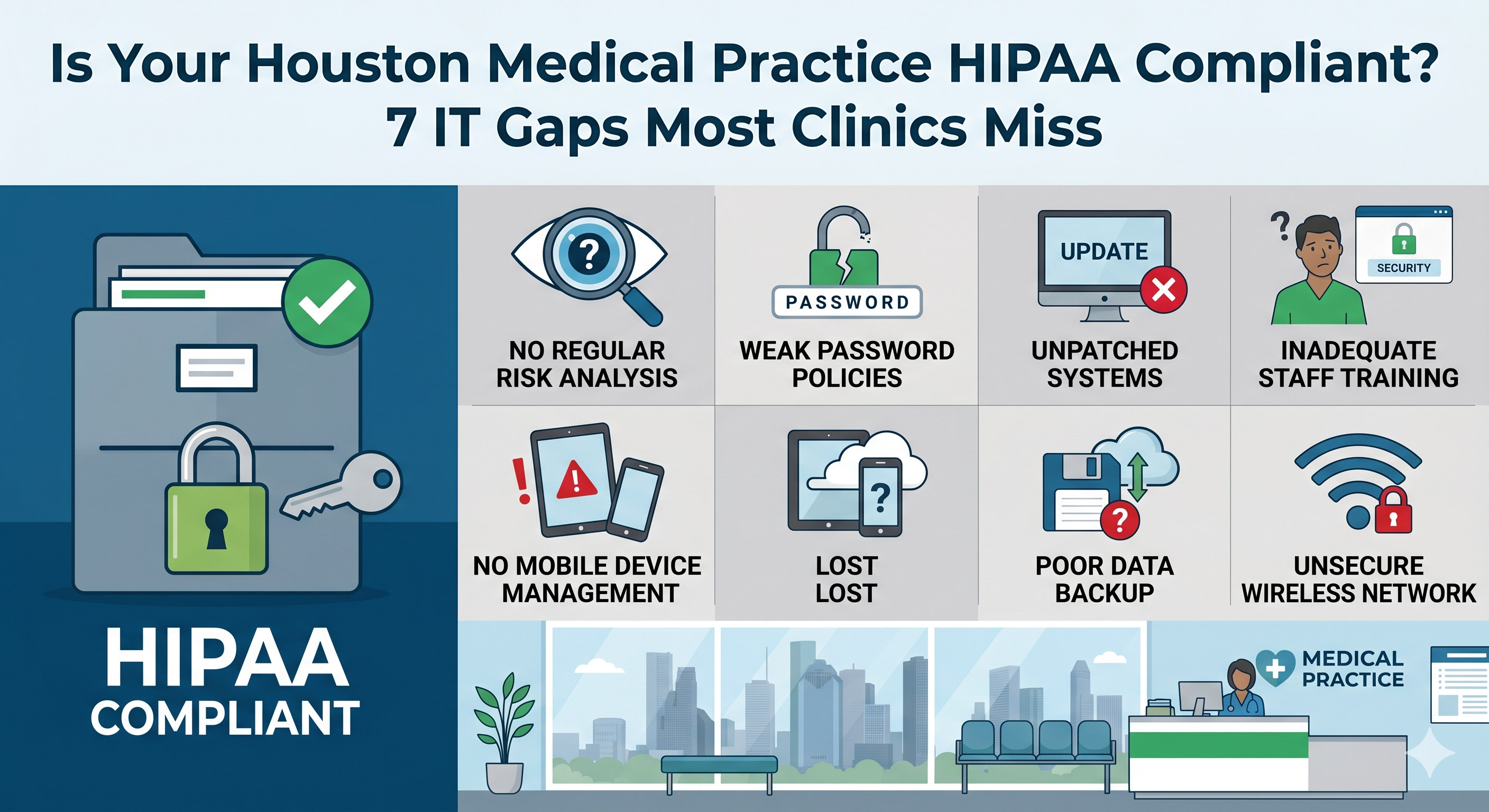
Most medical practices in Houston, Austin, and San Antonio believe they are HIPAA compliant — until an audit or breach proves otherwise. The reality: over 60% of healthcare data breaches are linked to IT security gaps that a managed provider could have prevented. And with OCR fines ranging from $100 to $50,000 per violation, the cost of non-compliance is real. Whether you run a dermatology clinic, a plastic surgery center, or a general medical practice, these 7 IT gaps are the most common — and the most dangerous — that we see in practices with 5 to 75 employees.
Why These 7 Gaps Are Your Biggest HIPAA Liability Right Now
OCR (the Office for Civil Rights, the federal agency that enforces HIPAA) has made clear that its enforcement priorities are shifting toward smaller practices. The days of assuming you are too small to be audited are over. In 2023 and 2024, multiple practices with fewer than 50 employees received six-figure fines for violations that a managed IT provider would have caught and prevented.
The 7 gaps below are not theoretical. They are the gaps Scorpion Technology finds most often when onboarding new healthcare clients in Houston, Austin, and San Antonio — practices that believed they were protected because they had a basic IT setup in place. Each gap is mapped to a specific security control, and each one corresponds to a feature in Scorpion's Assured managed IT plan.
Gap 1: No 24/7 Threat Monitoring on Clinical Workstations and Servers
Your clinical endpoints — workstations, laptops, servers storing patient data — are active targets. Without continuous threat monitoring and automated response, a ransomware attack or unauthorized access event can go undetected for days or weeks. Under HIPAA, you are required to implement technical safeguards that monitor and detect unauthorized activity. A basic antivirus alone does not satisfy this requirement.
Scorpion's Assured plan includes Managed EDR (Endpoint Detection and Response) with 24x7 SOC (Security Operations Center) response. That means a security team is actively watching your environment around the clock — not just alerting you after the fact, but actively containing threats before they spread. This is the standard of care that healthcare regulators expect.
Who needs this most: Practices that rely on EHR systems, PACS imaging, or store any PHI (Protected Health Information) on local devices.
Gap 2: No Monitoring for Compromised Staff Credentials
WordPress tag: <h2>Gap 2: No Monitoring for Compromised Staff Credentials</h2>
Employee usernames and passwords are routinely leaked in third-party data breaches — and your staff often reuses those same credentials on your clinic's systems. If someone's email and password are exposed on the dark web, a bad actor can use them to log into your patient portal, your billing system, or your cloud storage.
Dark Web Monitoring, included in the Assured plan, continuously scans criminal forums, hacker databases, and leaked credential lists for any accounts tied to your practice's domain. When a match is found, you're alerted immediately — before the credential can be weaponized against you.
HIPAA relevance: Failure to protect access credentials is cited in the majority of HIPAA breach notifications. A single compromised login can expose thousands of patient records.
Gap 3: Staff Have Never Been Trained to Recognize Phishing Attacks
Phishing is the #1 delivery method for healthcare ransomware. A front desk coordinator who clicks the wrong email attachment can bring down your entire practice. HIPAA's Security Rule explicitly requires workforce training as part of your compliance program — and "we told them to be careful" doesn't count.
Scorpion's Assured plan includes Phishing Simulation and Security Awareness Training. We send realistic fake phishing emails to your staff on a regular basis to measure who clicks. Staff who click get automatically enrolled in targeted training. This creates a measurable compliance record you can present during an audit.
What this prevents: Credential theft, ransomware delivery, business email compromise — all of which have resulted in 7-figure HIPAA settlements.
Gap 4: No Oversight on Cloud Apps Accessing Patient Data
Many practices have moved to Microsoft 365, Google Workspace, or cloud-based EHR platforms — but most have no visibility into which apps, integrations, or third-party connections are actually touching patient data. A staff member who connects an unauthorized app to your Microsoft 365 account could inadvertently give that app access to patient records, appointment data, or billing information.
Cloud Account Security Monitoring, included in the Assured plan, proactively watches your cloud environment for suspicious activity — unusual logins, unauthorized app connections, excessive data downloads, and configuration changes that could expose PHI. This satisfies the HIPAA requirement for monitoring access to ePHI (electronic Protected Health Information) in cloud environments.
Common scenario we see: A staff member connects a personal calendar or productivity app to Microsoft 365 without realizing it grants that third party access to patient appointment data.
Gap 5: Microsoft 365 Emails and Files Have No Independent Backup
Microsoft and Google do not guarantee recovery of deleted data beyond 30–90 days. If a ransomware attack encrypts your cloud data, if a disgruntled employee deletes records, or if an accidental mass-delete happens during a migration — you could lose years of patient communications, billing records, and internal files with no way to recover them.
HIPAA requires practices to maintain contingency plans and data backup procedures. Scorpion's Assured plan includes Microsoft 365 and Google Workspace Backup with 1-year retention. Your emails, files, SharePoint data, and contacts are backed up independently — not just relying on Microsoft's or Google's own recycle bin policies.
What practices get wrong: Assuming that using Microsoft 365 means your data is automatically backed up. It is not. Microsoft's SLA covers uptime, not data recovery.
Gap 6: Email Is Wide Open to Phishing, Malware, and Impersonation
Email is the primary attack vector for healthcare breaches. Standard spam filters — including Microsoft's default Defender — are not sufficient against sophisticated impersonation attacks, malicious links disguised as patient inquiries, or vendor impersonation emails requesting wire transfers or credential changes.
Advanced Email Filtering and Threat Protection is available as an add-on for Essentials and Assured clients, and is included in Complete. It adds a second layer of inspection on every inbound email — scanning links, attachments, sender behavior, and email content patterns that standard filters miss. For practices communicating with patients, insurance companies, and vendors daily, this is not optional.
HIPAA connection: Email is the most common entry point for PHI breaches. Unfiltered malicious email leads directly to ransomware, data theft, and mandatory breach notification — which costs an average of $10.9 million per healthcare breach (IBM, 2023).
Gap 7: Your Email Domain Has No Authentication — Making You Easy to Impersonate
If your practice's email domain is not protected with DMARC, SPF, and DKIM authentication records, anyone can send email that appears to come from your domain. This is how vendors get tricked into sending payments to fraudsters, how patients get deceived by fake appointment reminders, and how your domain ends up on spam blacklists — damaging your reputation and deliverability.
Managed DMARC, SPF & DKIM, included in the Assured plan, ensures your domain has proper authentication records in place and actively monitors compliance. This protects your practice's identity, prevents email spoofing, and satisfies a key technical safeguard requirement under HIPAA's Security Rule.
Real-world risk: We have onboarded practices where their domain had zero authentication records — meaning competitors, scammers, or anyone else could send email "from" their address with no detection.
What Closing These Gaps Looks Like in Practice
A Houston Dermatology Clinic That Was One Breach Away from a Fine
[PLACEHOLDER: Client name or description (e.g., 'A 12-provider dermatology group in southwest Houston')] A 12 provider dermatology group with 4 different offices through out Houston, Katy, Sugarland and Pearland came to Scorpion after failing a third-party HIPAA risk assessment. They were running unmonitored clinical workstations, had no email authentication, and had never conducted phishing training. Their Microsoft 365 data had no backup beyond Microsoft's default recycle bin.
After onboarding to Scorpion's Assured plan, we deployed endpoint threat monitoring with 24x7 SOC response, implemented dark web credential monitoring, launched quarterly phishing simulations with remediation training for all staff, activated cloud security monitoring across their Microsoft 365 tenant, and set up DMARC, SPF, and DKIM authentication on their domain.
Within 90 days: identified 3 compromised staff credentials, blocked 14 phishing simulations clicked by staff, reduced email spoofing incidents to zero, and passed their next third-party HIPAA audit with no critical findings
Their next risk assessment came back clean. More importantly, they had a documented compliance record — training logs, monitoring reports, and incident response documentation — that they could present to their EHR vendor, their malpractice insurer, and any future auditor.
Ready to Close These Gaps? Start with a HIPAA IT Assessment
If you are unsure whether your practice has any of these 7 gaps, the right first step is a Technology Assessment. Scorpion Technology conducts a full review of your current IT environment — endpoints, cloud accounts, email security, backup status, and access controls — and delivers a written report of where your practice stands.
Assessment fee: $300. That fee is credited in full toward your managed IT plan if you choose to move forward with Scorpion.
Practices in Houston, Austin, and San Antonio can schedule directly at ScorpionITSupport.com or by calling 713-623-1266. We work with dermatology clinics, plastic surgery centers, medical spas, and general medical practices — and we understand the compliance pressures that come with handling patient data every day.
About Scorpion Technology
Scorpion Technology has served small businesses and healthcare practices across Houston, Dallas, Austin, and San Antonio for over 19 years. We specialize in HIPAA-compliant IT for medical practices and professional services firms, with a 15-minute guaranteed response time for all managed clients. Our team is local, responsive, and built around keeping your practice running — not just fixing problems when they break. Learn more at ScorpionITSupport.com or call 713-623-1266.

